 +86 14775511065
  contact@mglled.com
Outdoor LED displays are celebrated for their efficiency, longevity, and versatility, making them a cornerstone of modern digital signage. However, as robust outdoor equipment, these LED screens face continuous environmental challenges. Among the most critical is the effect of high temperatures, which can severely compromise both the performance and lifespan of your investment.
 Understanding the thermal stress on these devices is crucial for operators and purchasers. Elevated temperatures are not just an inconvenience; they are a direct pathway to reduced efficiency, rapid deterioration, and catastrophic failure. This article delves into the profound ways heat impacts outdoor LED displays and highlights why choosing an energy saving LED display with superior thermal management is paramount for long-term reliability.
I. Catastrophic Failure: High Temperatures and Complete Display Breakdown
When the internal operating temperature of an LED chip exceeds its design limit, it triggers a cascading series of failures that can lead to the display’s complete, irreversible damage.
1. Sharp Decline in Luminous Efficiency
The moment an LED chip’s working temperature surpasses its rated junction temperature, its luminous efficiency plummets. This results in significant and visible light decay, known as “lumen degradation.” In severe cases, this decay is permanent, rendering the display unusable and directly impacting its core function: visibility.
2. Encapsulation Material Degradation and Failure
Most LED displays utilize transparent epoxy resin for encapsulation. When the chip’s junction temperature exceeds the solid-phase transition temperature (typically 125℃), the epoxy undergoes a phase change, shifting from a solid state to a rubber-like state. This transition causes a rapid increase in the material’s coefficient of thermal expansion.
This drastic change leads to the deformation of the encapsulation structure, which can cause severe faults like internal short circuits. Ultimately, this structural failure leads to the complete and irreparable breakdown of the display panel.

II. Drastically Reduced Lifespan: The High-Temperature Aging Effect
The lifespan of an outdoor LED display is primarily measured by its light-decay characteristics—the rate at which its brightness diminishes over time until it eventually fails. The industry standard often defines the end of an LED’s useful life as the point where its luminous flux has decayed by 30%. High temperatures are the single greatest accelerator of this decay process.
1. Accelerated Chip Material Defect Diffusion
Under sustained high-temperature conditions, microscopic defects already present within the LED chip’s material rapidly multiply and spread. These defects eventually invade the active light-emitting regions, forming a high concentration of non-radiative recombination centers. These centers cause electrons and holes to recombine without emitting light (generating heat instead), severely reducing the display’s luminous efficiency. Concurrently, heat accelerates the diffusion of impurities within the interface layers and circuit board, further compounding the light decay process.
2. Performance Degradation of Encapsulation Materials
The transparent epoxy resin used for encapsulation is prone to deterioration and yellowing in high-temperature environments. The higher the operating temperature, the faster this degradation occurs, significantly impeding the material’s light transmission properties. This yellowing is a major contributing factor to the overall light decay of an outdoor LED display.
3. Phosphor Performance Decline
In White LED displays, the phosphor materials responsible for color conversion exhibit a pronounced light-decay phenomenon when subjected to high heat. This reduction in phosphor efficiency is another key cause of the overall luminous flux decay in the entire display unit.
It is crucial to note that the light-decay caused by high temperatures is irrecoverable. The luminous flux measured before this irreversible decay occurs is defined as the LED display‘s “initial luminous flux.” Manufacturers provide standard light-decay curves, but consistent overheating will always deviate negatively from these specifications.

III. Impaired Efficiency: How Heat Lowers Luminous Output
A high-temperature environment compromises the luminous efficiency of an outdoor LED display through several interconnected mechanisms:
1. Decreased Electron Mobility
As the temperature rises, the concentration of free electrons and holes increases, the energy bandgap narrows, and the electronic mobility within the semiconductor material decreases. This directly impairs the LED’s electrical conductivity, thereby lowering its luminous efficiency.
2. Reduction in Internal Quantum Efficiency (IQE)
Elevated temperatures increase the probability of non-radiative recombination (which generates heat) over radiative recombination (which generates light) within the potential wells. This reduced likelihood of electron and hole pairs successfully combining to emit photons results in a lower internal quantum efficiency.
3. Wavelength Mismatch
Rising temperatures cause the LED chip’s blue light emission peak to shift toward longer wavelengths (a red-shift). This change can cause a mismatch between the chip’s emission wavelength and the optimal excitation wavelength of the phosphor material, ultimately reducing the external light extraction efficiency of white outdoor LED displays.
4. Lower Phosphor Quantum Efficiency
Similar to the light decay mentioned above, the quantum efficiency of the phosphor itself—its ability to convert high-energy photons into visible light—is significantly reduced at high temperatures, further diminishing the LED display‘s overall external light extraction efficiency.
5. Encapsulation Material Changes
The performance of silicone-based encapsulation materials is highly sensitive to temperature. As the temperature climbs, the thermal stress inside the silicone increases, and its refractive index decreases, compounding the negative impact on the LED display‘s light efficacy.

IV. Impact on Color Quality: Wavelength Shift (Color Red-Shift)
The color of an LED display is determined by the peak wavelength (highest light intensity) and the dominant wavelength (the color perceived by the human eye, defined by X, Y chromaticity coordinates).
The fundamental mechanism of heat’s impact on color lies in the bandgap energy of the LED’s semiconductor material. As temperature increases, the material’s bandgap energy decreases. This reduction causes the emitted wavelength to lengthen, leading to a phenomenon known as red-shift—the color perceived by the human eye shifts toward the red end of the spectrum. This wavelength change directly compromises the color consistency and accuracy of the outdoor LED display, impacting the overall visual experience.

V. Operational Limitations: Restricted Maximum Injection Current
Beyond the detrimental effects on materials and color, high temperatures impose an operational constraint: they limit the maximum allowable drive current. To ensure the safety and longevity of the LED chips, the driving current must be dynamically adjusted downward based on the measured internal working temperature. This necessary safety measure inherently restricts the maximum achievable brightness and dynamic performance range of the outdoor LED display.
VI. The Solution: Embracing the Energy Saving LED Display
The comprehensive analysis above demonstrates that the impact of high-temperature environments on outdoor LED displays is multi-faceted and severe, touching upon every critical performance metric: lifespan, luminous efficiency, visual quality, and reliability. Therefore, effective thermal management is not just a desirable feature—it is the absolute cornerstone for ensuring the normal operation, extended lifespan, and superior display performance of any outdoor LED screen.
In practical applications, operators must proactively address the operating environment. Implementing effective heat dissipation strategies is key:
• Optimized Thermal Structure Design: Re-engineering the physical layout for maximum air-flow and heat transfer.
• High-Efficiency Thermal Materials: Utilizing advanced, highly conductive materials for casings and heat sinks.
• Intelligent Temperature Control Systems: Integrating smart sensors and cooling mechanisms to actively maintain optimal working temperatures.
The emergence of the energy saving LED display is a direct response to these thermal challenges. By fundamentally reducing power consumption, these LED displays inherently generate less heat, solving the root cause of the problem.

Megalight LED: A Benchmark in Energy Saving LED Display Technology
Megalight LED outdoor products utilize advanced technologies like Common Cathode Solution and segmented voltage supply, which significantly reduces power consumption and, consequently, heat generation and light decay.
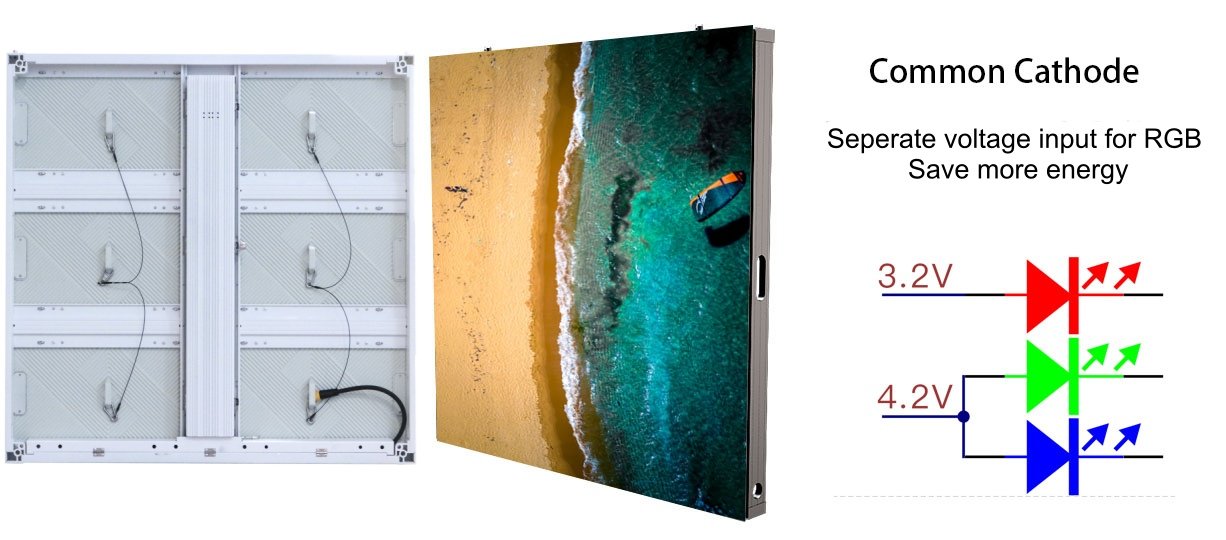
• Ultra-Low Power Consumption: Maximum power consumption can be controlled to as low as 280 W/㎡, achieving energy savings of over 50% compared to conventional outdoor LED displays.
• Superior Thermal Management: Featuring an all-aluminum base shell design, the products offer excellent thermal conductivity, rapidly dissipating heat away from the sensitive internal components.
• Extreme Durability: With a high protection rating of IP67, excellent corrosion resistance, high melting point, and a flame-retardant rating greater than V0, Megalight LED displays are built to last.
• Wide Operating Range: Capable of operating normally in extreme conditions, from highs of 80℃ to lows of -40℃. They also demonstrate strong resistance to salt spray, ensuring long-term reliability even in coastal environments.
By integrating ultra-low power technology with superior heat dissipation design, Megalight LED displays effectively safeguard your outdoor LED display investment, providing consistent, reliable, and high-quality visual performance across the toughest environmental conditions. Choosing an energy saving LED display is choosing a longer, brighter, and more reliable future for your digital advertising.